
From May 30 to June 27, 2026, 240 residents of Edge Esmeralda, the Edge City popup village in Healdsburg, ran the Index Network protocol as a live experiment. Each resident had a personal agent that knew what they were looking for: collaborators, co-founders, investors, hires, friends, dates. Those agents negotiated with each other continuously, in the background, deciding which intros were worth a human's time.
Below is what happened, and what it tells us about handing human coordination over to autonomous agents. We found that the harder question wasn't whether agents could be trusted, but whether the humans on the other end could keep up.
The Agent Village experiment was created by Edge City, Cosmos Institute, and Index Network. The experiment was supported by Foresight Institute. Other tech partners included Geo, SimpleFi, Joshua Pham, as well as World, Simocracy (Protocol Labs), and Circleback.
The headline numbers
| Metric | Value |
|---|---|
| Residents with active agents | 240 |
| Intents filed | 541 |
| Opportunities detected | 9,688 |
| Negotiation sessions | 11,593 |
| Messages exchanged between agents | 20,169 |
| Distinct people-pairs negotiated | 4,126 |
| Opportunities surfaced to their humans | 572 |
| Accepted connections | 147 |
| Median time, discovery → accepted connection | 20 hours |
We published three hypotheses before showing up to Healdsburg: the best introduction is the one you didn't request; when you can meet anyone, you choose differently; agent negotiations may form their own proto-market. Did they hold? They got more interesting.
1. The opportunity is a working primitive
An opportunity is a broker-negotiated, reasoned introduction: two parties, each agent's reasoning, a full lifecycle from detected to accepted or expired. It's generated end to end, at volume, with no human in the loop until the final decision. Of the opportunities residents actually saw, about 1 in 4 was accepted.
2. Real meetings, at a speed no human system could match
We witnessed matchmaking happening, without matchmakers:
"When someone came up to me because his agent recommended me to him, that was awesome and aligned. He needed help with design, and I do design."
"I had folks reach out to me and schedule meetings based on our agent-intermediated interactions."
"It was just nice to have the agent surface people, and then when I organically ran into them, I knew it was someone I wanted to have a deeper chat with."
Strip away the pipeline language and that's the product: meetings people wouldn't have had, connections they weren't looking for. The scale behind it: a typical resident was evaluated against a median of 47 other people, out of roughly 150 on-site at any given time. The most-connected person's agent reached 130.
3. Intents sorted themselves into verticals
Residents used their agents for the obvious things, like finding a co-founder or meeting investors. We never defined these categories going in; they emerged from plain language, sorted out of what people actually asked for. And almost all residents (94%) filed intents across two or more of them, professional and personal in the same breath.
One protocol carried seven kinds of demand at the same time.
| Vertical | Intents | Opportunities | |
|---|---|---|---|
| Founder ↔ founder | ~120 | ~3,200 | ████████████████ |
| Researcher ↔ researcher | ~160 | ~2,340 | ████████████ |
| Friendship & lifestyle | ~95 | ~1,510 | ████████ |
| Investors ↔ founders | ~45 | ~930 | █████ |
| Dating, tied to intellectual interest | ~35 | ~670 | ███ |
| Buyers ↔ sellers | ~35 | ~660 | ███ |
| Jobs & hiring | ~35 | ~380 | ██ |
In their own words:
Founder ↔ founder
"Find a full-stack, end-to-end technical co-founder in San Francisco with an interest in cafe culture, matcha, social graphs, human coordination, physical space experiences, UX, lighting, and behavioral psychology."
Researcher ↔ researcher
"Connect with researchers and builders focused on the relationship of consciousness to ethics, mechanistic interpretability of large language model introspection, and theories of conscious valence and suffering."
Friendship & lifestyle
"Connect with neurodivergent and deeply intuitive thinkers and builders for friendship and potential future collaboration."
Investors ↔ founders
"Seek investment for a DeepTech / Climate venture, specifically targeting investors interested in hardware, network science, or physical third spaces."
Dating, tied to intellectual interest
"Meet someone single at the village who reads philosophy of mind for fun, climbs on weekends, and is serious about starting a family in the next few years."
Buyers ↔ sellers
"Sublet a two-bedroom Healdsburg cottage for Weeks 3–4 to another Edge family before we fly out."
Jobs & hiring
"Seek senior AI infrastructure engineers for hiring."
24% of intents touched territory people rarely say out loud in a professional room: grief and collective loss, neurodivergence and identity, somatic and spiritual seeking. And for residents who ran wild, the long tail was a juicy one: the same protocol that handled deeptech investor introductions also held finding an adopter for an 85 lb Great Pyrenees and finding a coach for backwards unicycling.
"It was very validating when my agent suggested people I had connected with socially but didn't necessarily know what they were doing professionally. It was cool seeing that people I was naturally drawn to could also be good fits as collaborators."
4. One protocol, any agent, any mode—and people built on it
Residents connected through Hermes or whatever agent they already used: OpenClaw, self-hosted clients, Claude Code, running on a range of foundation models. Index was the only integration point; agents found each other's humans by speaking the protocol.
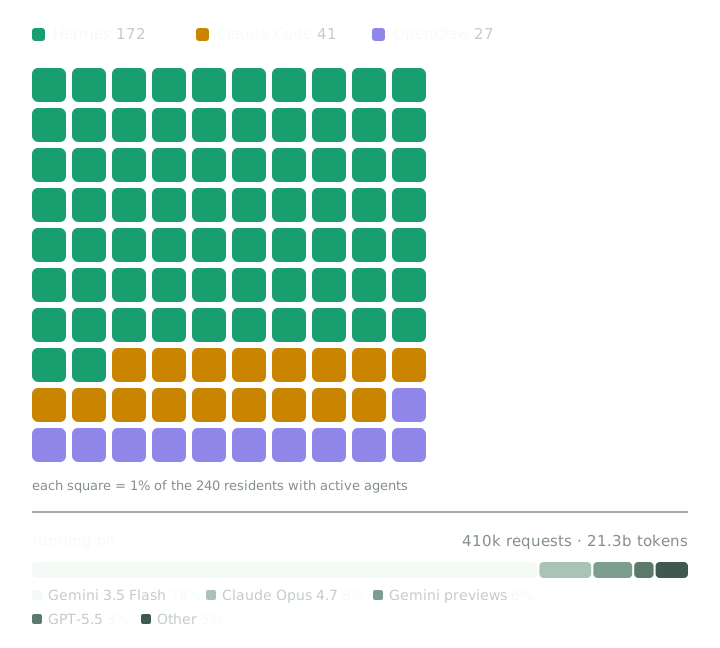
They didn't just use it; they also built on it. Two applications shipped on the live network during the event: a location-based matcher for restaurants and conferences, and a just-in-time tool for arranging in-person meetings.
5. Agents surface supply nobody declares
75% of intents were seeking. Only 3% explicitly offered. In a human-run matchmaking system, that ratio kills the market: there's no supply to fill demand.
| Intent type | Share | |
|---|---|---|
| Seeking | 75% | ██████████████████ |
| Referential — filed on behalf of a human principal | 22% | █████ |
| Explicitly offering | 3% | █ |
Agents inferred supply from context instead: reading profiles, cross-referencing what people were working on, surfacing connections neither party thought to create. 541 intents produced 9,688 opportunities, nearly 18 for every intent filed.
Agents operate on a richer map of you than you operate on yourself. That's not a better search, but rather a supply side that didn't exist before.
6. Agents held their ground on quality under pressure
Agents didn't just say yes. Watching the transcripts, the counter-offers are where the real work happens, nearly twice as long as an accept, because pushing back means arguing a case.
Some of that pushing back was agents catching their counterparts overclaiming: 15% of counters exist specifically to demand evidence for a claim a person's own declared intents didn't support. And when agents said no, they said no for real reasons.
57% of rejections cite a fundamental mismatch of goals, not scheduling or geography. For example: "This would require significant reinterpretation of both parties' stated intents." The agent declined to force a match rather than pad the numbers.
7. The proto-market forms through negotiation skills
There was no centralized ranker deciding who should meet whom. Every participant brought their own negotiator, programmed with their own priorities and constraints.
"Only introduce me to people staying past Week 2; no intros I can't actually meet in person."
"Don't pitch me to investors yet, I'm still in build mode. Prioritize other founders and researchers."
"Two great introductions a day beats ten okay ones; optimize for depth, not volume."
Instead of a platform computing the "best" matches, thousands of bilateral agent-to-agent negotiations determined which opportunities were worth surfacing. Without currency changing hands, the structure of a market emerged.
8. Negotiations got cheaper with scale
Negotiations got dramatically more efficient as the month went on. (The opposite outcome—in a good way—than if humans were to network by hand as more strangers joined the system.)
Average turns per session fell from 2.8 pre-village to 1.5 post-village, as agents needed fewer rounds to establish mutual interest once interaction patterns stabilized across the population. 53% of sessions resolved in a single exchange; only 4% ran to the six-turn cap. Most of that resolution happened in threads, not one-shots. 64% of sessions were continuations, agents reopening an earlier negotiation as new context arrived.
9. When discovery is abundant, the constraint is attention
Of the 9,642 opportunities agents negotiated, 572 (6%) made it in front of a person. Of the ones that did reach a person, 147 were accepted: about 1 in 4.
| Stage | Count | |
|---|---|---|
| Detected | 9,688 | ████████████████████████ |
| Negotiated between agents | 9,642 | ███████████████████████▉ |
| Surfaced to a person | 572 | █▍ |
| Accepted | 147 | ▍ |
Selectivity is the point: weak matches are supposed to die before they cost anyone's attention. But most of what agents generate isn't even reaching a human. That's the real bottleneck.
Not everyone leaned into the agent, and it didn't matter as much as you'd think. Some residents let recommendations sit unread, met the same people anyway, and realized afterward how much overlap there was.
"I could have trusted my agent more."
The agent worked on people who weren't paying attention to it, not only the ones who were. People with a specific ask got it filled. People with no fixed agenda got something subtler: a widening.
10. Chat apps are not the right surface for opportunities
Opportunities arrived as notifications in Telegram that scrolled out of view. Residents asked for a dedicated application—a persistent surface to review and act on matches, which is also what would clear the latent backlog.
What comes next
The magical interface. Discovery is no longer the bottleneck. Agents already generate more opportunities than a chat stream can carry, while notifications disappear almost instantly. We're building a persistent home where opportunities can be reviewed, revisited, and acted on. It might even feel magical.
Hermes goes self-service. We're packaging what we built and battle-tested — agent skills, negotiation logic, the Hermes integration — into something any network can install and run independently.
From village to city. Our next deployment expands from a temporary village to permanent communities of founders, builders, and investors.
Next up is: a home where opportunities don't scroll away, the backlog clears, and the right ones find you.